
In July/September of 2010, I blogged about a booklet produced by de Pamiri handicrafts in Tajikistan. The booklet is called "Falling Star" and contains a collection of images of traditional motifs used in the making of crotcheted colourwork socks made in the Pamirs. The booklet contains some charts, but they are photos of hand-drawn charts rather than the polished charts that western crafters are used to seeing in their glossy magazines and reference books. The booklet is also written entirely in Russian.
I have two friends on Ravelry (one from Germany and one from Russia) who have also gone through the process of trying to purchase this booklet online, and both of them experienced serious difficulties with making payments. In addition, my friend from Russia has now been waiting months to receive the booklet she paid for. This causes me a great deal of anguish as I was the one who blogged about the booklet in the first place.
From what I am hearing, it also transpires that the price of the booklet has now been jacked up to the equivalent of about $US35, when it was originally about $US15 when I bought it in 2010. It is, of course a freemarket world these days, and de Pamiri is fully entitled to charge whatever the hell they please for this booklet, but crafters in the west can take it or leave it. In my opinion, this booklet is not worth $US35. Yes, it contains photos of motifs that people in the west have probably never seen, but it is too poorly produced and laid out to warrent a $35 pricetag. For $35, I as a consumer, would expect a book (not a booklet) of at least 100 pages with computer-generated charts, and detailed text in English, including instructions on how Pamiri socks are traditionally made.
It pains me to have to write this post, but I am going to say that I would now discourage people from trying to get hold of this booklet via mail order online.
Unless you go to Tajikistan for a holiday, and can walk into de Pamiri's shop to hand your money over the counter to buy the booklet, think twice about going to the trouble of buying it. The online buying process is not a simple PayPal transaction with someone in the USA or the UK where you are relatively assured of getting your parcel in the post within a couple of weeks.
Personally, it took me 8 weeks of emailing with de Pamiri to get what I wanted, and 4 weeks to get the parcel (and I was fully prepared to wait for that to be longer since I had heard that mail going out of Tajikistan into Europe can be hit and miss). My local bank here in The Swamp freaked out about de Pamiri's bank payment/routing process, so in the end I paid them with Western Union, and that (luckily) worked out for me. But I didn't have to pay $35 plus postage, so I had less to lose. My friends also had difficulties with the payment process. In one case, de Pamiri insinuated that one of my Ravelry friends was lying about having paid for the book, when in actuality they had failed to properly read my friend's email bank payment slip.
Overall, the mail order process for purchasing this little booklet is very antiquated and can get quite stressful, so if you are not prepared to be overcharged, and to go through hellish uncertainty about receiving this booklet by mail, don't even attempt the transaction.
You have all been forewarned.
Sunday, May 20, 2012

Friday, October 1, 2010
Bosnian Crochet and Shepherd's Knitting Videos
There's no sound for these videos, but I was asked how I do it by a couple of people, so hopefully these go some way to showing that.
Single colour bosnian crochet is just a slip stitch through the back of each loop.
Single Colour Bosnian Crochet:
Single colour shepherd's knitting is just a slip stitch through the front of each loop.
Single Colour Shepherd's Knitting:
The next video is for bosnian crochet with two colours, for Ross who asked a few days ago. This is just one way to do it. I have also tried doing it purlwise, where I crochet from the back of the work in the old eastern style and "float" the colours at the back rather than "carrying" them (which is like extreme trapping in knitting) as I do in this video. I had a bit of trouble keeping the video centred, but hopefully it's viewable.
Basically I just pick up whichever colour I need from the front or back of the other colour so that it traps the colour that needs to be carried behind the work.
Bosnian Crochet in Two Colours:
Single colour bosnian crochet is just a slip stitch through the back of each loop.
Single Colour Bosnian Crochet:
Single colour shepherd's knitting is just a slip stitch through the front of each loop.
Single Colour Shepherd's Knitting:
The next video is for bosnian crochet with two colours, for Ross who asked a few days ago. This is just one way to do it. I have also tried doing it purlwise, where I crochet from the back of the work in the old eastern style and "float" the colours at the back rather than "carrying" them (which is like extreme trapping in knitting) as I do in this video. I had a bit of trouble keeping the video centred, but hopefully it's viewable.
Basically I just pick up whichever colour I need from the front or back of the other colour so that it traps the colour that needs to be carried behind the work.
Bosnian Crochet in Two Colours:
Saturday, August 7, 2010
Hooks, shepherd's knitting, and a wonderful package from Tajkistan
On August 7, I started this post and then put it on hold until today (September 6 - don't let the blogger date above mislead you). :-P
At the time I was busy spinning and dyeing one of my Mergelland fleeces, and making a hook for my long-planned Tajik socks.
Hooks
First the hook which I made according to Flosiepoo's Pen Tutorial: The wood for my hook is from the dead branch of a purple beech tree which I found whilst out walking one afternoon.
To make the hook, I first printed out Flosiepoo's "slim" template to scale and then cut it out. Then on a sunny June morning I sat outside with a small hacksaw, stanley knife and two different grades of sandpaper, plus a nail file. I hacksawed the branch to about 12.5cm as instructed in the tutorial. Then I whittled the hook end roughly into shape, and then the handle. As I whittled, I would keep putting Flosiepoo's cut-out template over my shape to check how close I was to the template. I'd say the whole process took 4-5 hours. But if you undertake something like this on a fine day, it's a very relaxing process.
Later, over the course of a week, I did a lot of swatches to test the hook. What I discovered was that my actual hook was way too sharp, so I had to constantly modify it as I swatched. In the end it looked a lot more like Flosiepoos hook, and a lot less like the commercial Swedish smygmaskvirkning hooks that I see all over the net. These, for example, are useless:

Anyone who has one of these hooks and disagrees should post me a youtube video of themselves actually using such a hook in a project before I will believe that these sorts of hooks are of any use.
If the hook is too sharp, it will constantly snag the plies of your yarn, which is very annoying. Also the heads of those commercial Swedish hooks are way too wide. The aim of the head shape is to allow you to enter the flattened slip stitch relatively gently, without snagging or splitting the plies of your yarn. The shaft of the hook is what does the work to stretch the stitch open for the subsequent pullthrough, so there is no need for such a wide head at all.
Anyway, for those who like the hook but not the thought of making one, Flosiepoos may soon be selling some of her mother's handmade hooks on Etsy, so keep an eye out for that!
Shepherd's Knitting
I've also been washing Mergalland fleece, and spinning, and dying, all for the purposes of making a Tajik-style proto-sock. Tajik socks are unique among Central Asian socks in that they utilize crochet, and/or a combination of crochet and knitting. Tajik socks are created with the use of shepherd's knitting/shepherd's stitch or "schaapherderssteek" as it is known to oldtimers here in The Swamp (that's "The Netherlands" for the benefit of non-Aussies).
Here is my proto-sock when I began:

And here it is as I progressed a little further and began knitting:

The sock is a bit further now and I'll post pictures when I finally get it done (I have no idea when that will be since I have 3 other more urgent projects on the go at the moment).
OK, so what is this "shepherd's knitting"/shepherd's stitch? Well, basically it's slip stitch crochet through the front of the loop, as opposed to "Bosnian Crochet" which is slip stitch crochet through the back of the loop. It's one of the simplest stitches there is but you can do it in spirals and in colour in order to make socks - which is what the women of the Pamirs (in what is today "Tajikistan") do with great skill. From what I have read, the technique became known as "shepherd's knitting" in ye olde days because the fabric produced looks a little like it is knitted rather than crocheted. I can sort of see this when you do it in one colour, but if you start doing it with colour motifs, the motifs have a definite slant to them, so it's more recognizeable as crochet.
So anyway, today I decided to finally finish this post because I received a long-awaited package from Tajikistan, which contained two precious items. The first of these, is a booklet/brochure called “Falling Star” by Parpisho Qimatshoyev, and the second is a Pamiri hook (I have been told that these are best referred to as Pamiri since the people of the pamirs consider themselves to have been assimilated by the Tajiks).
Falling Star
This is probably the only publication in existance at the moment which contains images and a few graphs of the Pamiri motifs which appear on their socks. It is not exactly a "book", but instead a 29 page brochure, but it's absolute gold - at least to someone like me who is always on the lookout for beautiful previously unknown Central Asian motifs to incorporate into my crafting. The brochure is written entirely in Russian as well, so unless you are Russian, or curious enough to try google-translating it (yeah, I'm mad enough), it's not the sort of thing you'll be able to sit down with and read with a nice cuppa and some bickies. But my reaction upon looking at all of the pretty photos was "OMG - so beautiful... Wow" followed by drooling and wishing that I could speak Russian. :-D
So without further ado, here is what the cover looks like:

Also in the pic above, you will notice the unique Pamiri hook, which is used to crochet socks. This doesn't come with the book. And here's a cloesup of the hook itself for those curious about how it compares to smygmaskvirkning hooks or Dutch hooks:

Also a sneek peek at one page inside the book - one with pictures of the Pamiri hook used for shepherd's knitting:

At the time I was busy spinning and dyeing one of my Mergelland fleeces, and making a hook for my long-planned Tajik socks.
Hooks
First the hook which I made according to Flosiepoo's Pen Tutorial:
 The wood for my hook is from the dead branch of a purple beech tree which I found whilst out walking one afternoon.
To make the hook, I first printed out Flosiepoo's "slim" template to scale and then cut it out. Then on a sunny June morning I sat outside with a small hacksaw, stanley knife and two different grades of sandpaper, plus a nail file. I hacksawed the branch to about 12.5cm as instructed in the tutorial. Then I whittled the hook end roughly into shape, and then the handle. As I whittled, I would keep putting Flosiepoo's cut-out template over my shape to check how close I was to the template. I'd say the whole process took 4-5 hours. But if you undertake something like this on a fine day, it's a very relaxing process.
Later, over the course of a week, I did a lot of swatches to test the hook. What I discovered was that my actual hook was way too sharp, so I had to constantly modify it as I swatched. In the end it looked a lot more like Flosiepoos hook, and a lot less like the commercial Swedish smygmaskvirkning hooks that I see all over the net. These, for example, are useless:

Anyone who has one of these hooks and disagrees should post me a youtube video of themselves actually using such a hook in a project before I will believe that these sorts of hooks are of any use.
If the hook is too sharp, it will constantly snag the plies of your yarn, which is very annoying. Also the heads of those commercial Swedish hooks are way too wide. The aim of the head shape is to allow you to enter the flattened slip stitch relatively gently, without snagging or splitting the plies of your yarn. The shaft of the hook is what does the work to stretch the stitch open for the subsequent pullthrough, so there is no need for such a wide head at all.
Anyway, for those who like the hook but not the thought of making one, Flosiepoos may soon be selling some of her mother's handmade hooks on Etsy, so keep an eye out for that!
Shepherd's Knitting
I've also been washing Mergalland fleece, and spinning, and dying, all for the purposes of making a Tajik-style proto-sock. Tajik socks are unique among Central Asian socks in that they utilize crochet, and/or a combination of crochet and knitting. Tajik socks are created with the use of shepherd's knitting/shepherd's stitch or "schaapherderssteek" as it is known to oldtimers here in The Swamp (that's "The Netherlands" for the benefit of non-Aussies).
Here is my proto-sock when I began:

And here it is as I progressed a little further and began knitting:

The sock is a bit further now and I'll post pictures when I finally get it done (I have no idea when that will be since I have 3 other more urgent projects on the go at the moment).
OK, so what is this "shepherd's knitting"/shepherd's stitch? Well, basically it's slip stitch crochet through the front of the loop, as opposed to "Bosnian Crochet" which is slip stitch crochet through the back of the loop. It's one of the simplest stitches there is but you can do it in spirals and in colour in order to make socks - which is what the women of the Pamirs (in what is today "Tajikistan") do with great skill. From what I have read, the technique became known as "shepherd's knitting" in ye olde days because the fabric produced looks a little like it is knitted rather than crocheted. I can sort of see this when you do it in one colour, but if you start doing it with colour motifs, the motifs have a definite slant to them, so it's more recognizeable as crochet.
So anyway, today I decided to finally finish this post because I received a long-awaited package from Tajikistan, which contained two precious items. The first of these, is a booklet/brochure called “Falling Star” by Parpisho Qimatshoyev, and the second is a Pamiri hook (I have been told that these are best referred to as Pamiri since the people of the pamirs consider themselves to have been assimilated by the Tajiks).
Falling Star
This is probably the only publication in existance at the moment which contains images and a few graphs of the Pamiri motifs which appear on their socks. It is not exactly a "book", but instead a 29 page brochure, but it's absolute gold - at least to someone like me who is always on the lookout for beautiful previously unknown Central Asian motifs to incorporate into my crafting. The brochure is written entirely in Russian as well, so unless you are Russian, or curious enough to try google-translating it (yeah, I'm mad enough), it's not the sort of thing you'll be able to sit down with and read with a nice cuppa and some bickies. But my reaction upon looking at all of the pretty photos was "OMG - so beautiful... Wow" followed by drooling and wishing that I could speak Russian. :-D
So without further ado, here is what the cover looks like:

Also in the pic above, you will notice the unique Pamiri hook, which is used to crochet socks. This doesn't come with the book. And here's a cloesup of the hook itself for those curious about how it compares to smygmaskvirkning hooks or Dutch hooks:

Also a sneek peek at one page inside the book - one with pictures of the Pamiri hook used for shepherd's knitting:

Saturday, June 12, 2010
Started prepping and spinning a Mergelland fleece


Today I finished my first skein of yarn from the first of my six Mergelland fleeces. I couldn't find any info on the internet about how people prep this wool for spinning, and this fleece (like the Drents fleece I started with 2 years ago), seems to be regarded by the Dutch as "rough" and fit only for felting amd carpet and weaving. Many of the Mergelland fan sites however, claim that the wool is "easy to spin". That's true, but the actual prepping takes a bit of extra time (as with the wool from most of these heath sheep breeds).
To prep the wool I used combs because this fleece has a long staple length. The basic problem with this wool is that the locks are composed of both hair and a fine underdown. Unlike the locks on a Drents fleece though, it's rather difficult to pull out the course hairs. I started cutting off the course hairs at first, but that was a bit too time consuming. In the end I just combed the locks, planked them, and then spun the resulting top. This stuff wants to be spun really fine too because it's quite longwool-like.
For the next skein, when I plank a sliver I am going to leave off the last bit of the planked sliver before I lash it back on for another combing. I am hoping that this will get rid of much of the hairs.
Saturday, June 5, 2010
Mergelland Fleeces
Last Friday I received not 2, but 6 (!!!) Mergelland fleeces in return for my sock knitting. These fleeces are enormous, and I am not sure how they are classified. As a heath sheep, the Mergellanders seem to have a "mixed coat", but not like the Drents Heath sheep that I first learned to spin with. There is less hair on each lock. The wool is also quite lusterous.


Today I started washing one fleece. Here are the fluffy white clouds of joy drying and ready for combing:


In the meantime, I have started to knit a thick Jacob wool hat for my husband so that he will have a new warm hat for the winter:
 I spun some of my separated Jacob wool from last week on my Louet, and this time I tried to spin as thickly as I could.


Today I started washing one fleece. Here are the fluffy white clouds of joy drying and ready for combing:


In the meantime, I have started to knit a thick Jacob wool hat for my husband so that he will have a new warm hat for the winter:
 I spun some of my separated Jacob wool from last week on my Louet, and this time I tried to spin as thickly as I could.
Wednesday, May 19, 2010
Jacob Fleece
I finally got around to starting to wash a Jacob fleece that's been in my shed since the end of last summer. I have been feeling very guilty about it, so it's a relief to finally be getting into it. The fleece is a two colour fleece, so I began by separating the brown wool from the white wool. Here's a picture of the fleece after I got most of the brown out: Bear in mind that this is a fleece from a Dutch farmer, and around these parts there are no such things as "coated fleeces", or "best-in-show fleeces". The wool comes off the sheep - grass and all, and that's what you get. Check out the lovely crimp though:
 And here is the lovely chocolate-coloured wool with sun-bleached tips drying (yes, I have no racks so it just gets hung up):
 Bear in mind that this is a fleece from a Dutch farmer, and around these parts there are no such things as "coated fleeces", or "best-in-show fleeces". The wool comes off the sheep - grass and all, and that's what you get. Check out the lovely crimp though:
 And here is the lovely chocolate-coloured wool with sun-bleached tips drying (yes, I have no racks so it just gets hung up):
Sunday, May 16, 2010
Fries melkschaap socks completed


The second pair of socks are now complete, so I can get back to writing my pattern for the goat's head socks at last.
Friday, May 7, 2010
Fries melkschaap socks underway
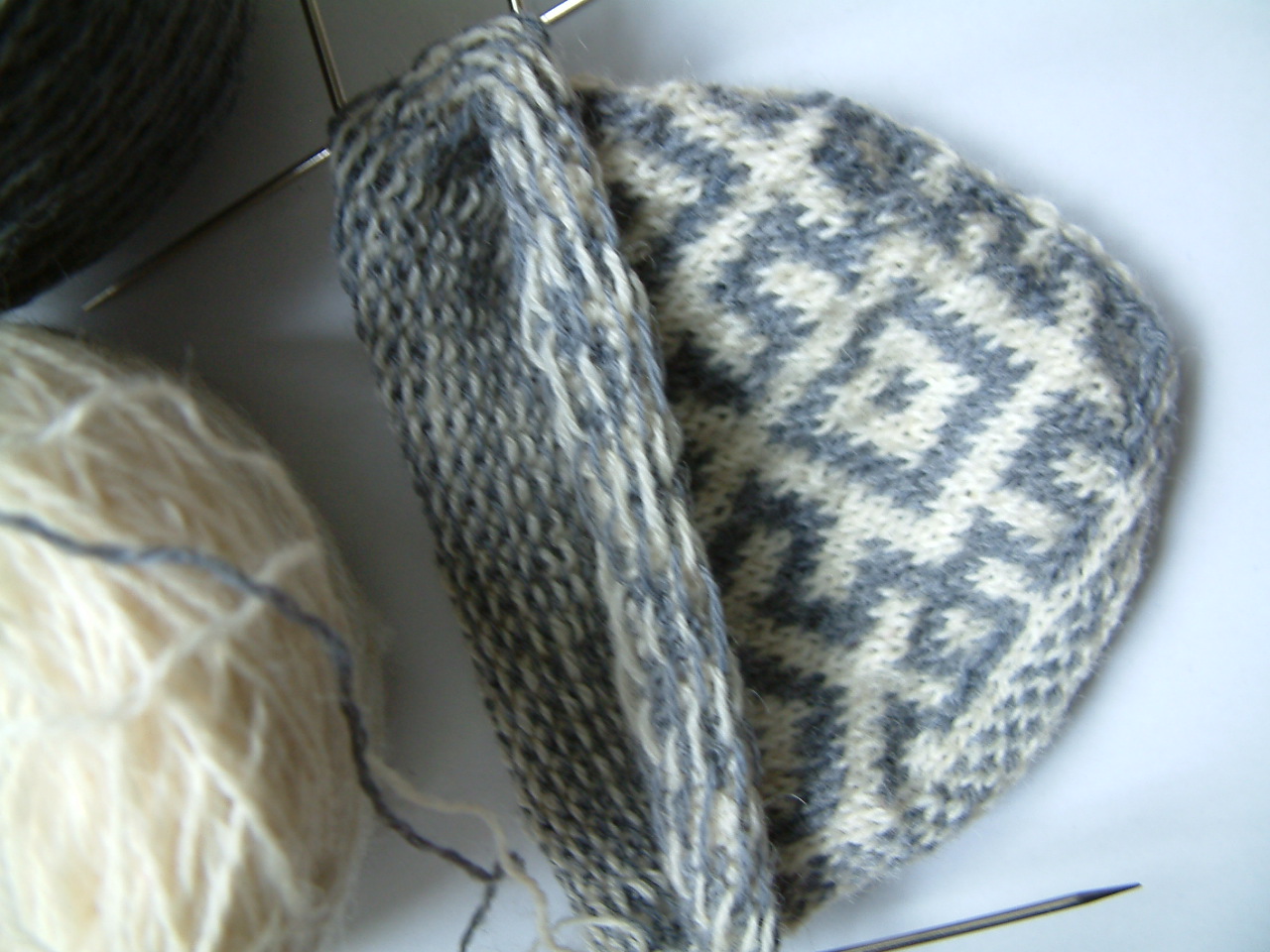
I split the skeined yarn (pictured in my last post) in half, and dyed one half with logwood. I mordanted the yarn with alum (no tartaric acid) and I added about 6 teaspoons of soda ash to to the dyebath hoping to get a deep purple colour. The dyebath colour did indeed look a deep bluey purple, but the resultant colour on the yarn turned out a sort of lovely steel grey. Next time NO soda ash!
I started these socks with a motif from Anna Zilboorg's Magnificent Mittens book, and knit half the sock before deciding that it looked quite aweful in steel grey and white. So yesterday I frogged it and started again. In the end,I figured I'd just do motifs to match the ones in the first pair of socks, so these will be kind of "his and hers" matching socks.
Monday, May 3, 2010
Gearing up for another pair of socks
Back in January I spun and knit a pair of socks for a friend of my mother-in-law, which were these:

I had also agreed to knit a pair of handspun socks for his wife, and I finally finished spinning for them today. The yarn I spun for them is a 3-ply fingeringweight yarn from a Fries Melkschaap fleece:

 I have a rough idea in my head for a pattern for a simple pair of stranded socks in two colours for this yarn, so I have to halve the yarn that I have here and dye one lot before I can get started, and that will probably be later in the week.
Meanwhile, I am still slogging along on a pattern for my goatshead socks, but I fear that the next project will have to take precedence since I am supposed to be getting 2 new fleeces in return. Most farmers are now shearing too, so I have to get a move on to keep my promise on this second pair of socks.

I had also agreed to knit a pair of handspun socks for his wife, and I finally finished spinning for them today. The yarn I spun for them is a 3-ply fingeringweight yarn from a Fries Melkschaap fleece:
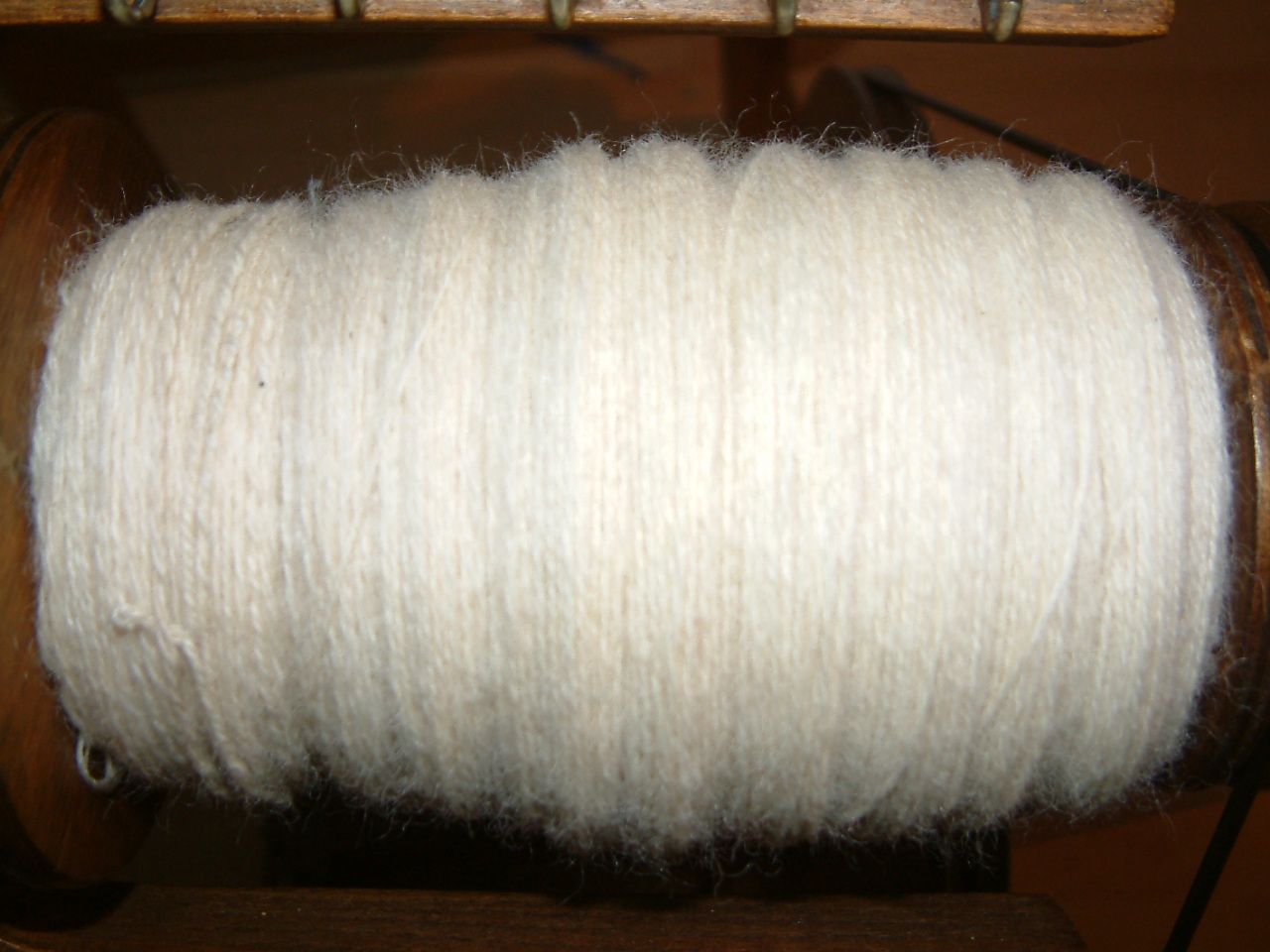
 I have a rough idea in my head for a pattern for a simple pair of stranded socks in two colours for this yarn, so I have to halve the yarn that I have here and dye one lot before I can get started, and that will probably be later in the week.
Meanwhile, I am still slogging along on a pattern for my goatshead socks, but I fear that the next project will have to take precedence since I am supposed to be getting 2 new fleeces in return. Most farmers are now shearing too, so I have to get a move on to keep my promise on this second pair of socks.
Saturday, May 1, 2010
The Goat's Head Socks are "finished"

The socks are finished in the sense that I now have a "protosock" and a proper sock to wear.
I just have a few videos left to edit to go with the pattern.
ETA: pattern for these is up.
Friday, April 23, 2010
Turkmeni Goat's Head Socks: Video of three colour carry and dominance order
After a mini conversation on ravelry the other day about colour dominance when purling from the purlside wrt multiple colours, I decided to vlog it on my youtube channel. The video is about 3 colour carries, and this is it:
Friday, April 2, 2010
Turkmeni Goat's Head Socks Update
Update on my Turkmen socks - I have finally finished one sock:


I have to say that a three colour carry using the old eastern style of knitting is easy relative to doing it continentally (with or without a yarn guide).


I have to say that a three colour carry using the old eastern style of knitting is easy relative to doing it continentally (with or without a yarn guide).
Tuesday, March 23, 2010
Turkmeni Goat's Head Socks
 Ha! Another post for 2010! :P
I am currently knitting a toe-up sock with Turkmeni motifs. The motifs are from a pair of Turkmeni slippers that I now own, and they are of great interest to me as a knitter who enjoys stranded knitting. I am reliably informed that the motif on these socks is known in Turkmenistan as "the goat's head" - kind of reminds me of the Turkish "ram's head" motif. But the thing that excites me is that the pair of slippers I own were knit with the yarn tensioned around the neck in the old eastern way, and utilize a 3 colour carry. The great beauty of knitting with the yarn tensioned around the neck is that multiple colour carries are easy, and instead of it being annoying to look at the floats rather than the pattern, it is fascinating to see how carrying the colours in a particular way affects colour dominance.
Anyway, as the slippers do not fit me, I have charted the motifs and I'm now in the process of creating a pair of socks (not slippers) which use the motif on the slippers.
Thursday, March 18, 2010
Bosnian crochet in Colour
This maybe the only post that I make this year because of my infrequent blogging habits, but I have been inspired by a couple of posts on Ravelry, the most recent being this one.
By shear coincidence, over the last couple of weeks I've been experimenting with Bosnian/slip stitch and other forms of crochet. My chief interest though is in Bosnian or slip stitch crochet which I blogged about a couple of years ago (in another rare post). Over the last year or so I have been collecting images of crocheted socks from Central Asia which utilize this simple but much ignored crochet stitch. Much as I would like to post images here, I am going to refrain because it would probably be a violation of some form of copyright.
Instead, here are some images of my own. These are test swatches that I crocheted using colourwork slip stitch crochet and motifs I have seen in eastern socks:
 The above is slip stitch (aka Bosnian) crochet through the back loop carrying three colours.
In the following image the black and white section is slip stitch crochet through the front loop in two colours.
 I am hoping to one day crochet a pair of Tajik-style socks in this manner, so just doing a bit of experimentation for the time being.
I have also made myself a couple of crochet hooks for the purpose. Here is a picture of one of the hooks:
 It doesn't have the thick handle like on pjoning hooks, but the head of the hook is relatively flat so it slides nicely into the slip stitches which tend to lie rather flat. I am thinking of putting a nice fimo handle on it, but it seems ok to use as is. I made this hook from a "twig" from our privet (or maybe even box) hedge that my husband pruned earlier this year.
Tuesday, May 5, 2009
Finished my socks

I finally finished these socks a couple of weeks ago, and they were an interesting knit. I put the videos in my last post on youtube, but have since taken them down for hopefully a clearer video of how to "trap" or "catch" with stranded knitting around the neck.
My youtube channel is gradually building up as I make interesting discoveries in the world of stranded knitting around the neck.
But for now, I am working on a pattern for a new pair of Central Asian style socks, and also spinning for them, so it will probably be a while before I get around to adding more discoveries.
Wednesday, March 25, 2009
Sock progress
Just a quick update today re my sock with Bosnian motifs. Before I started the colour stranded sections, I dug up a Dutch handcrafting magazine that my mother-in-law had lent me. At the end of the magazine was an article about Bosnian socks, in which it says that the coloured sections of the socks are knit with just a single stand of coloured yarn. So the socks don't use intarsia-in-the-round! This is actually making the knitting a little easier, and the motifs still look ok.
Friday, March 20, 2009
Turkish socks: Central Asian/Mediterranean (aka "Portuguese knitting") stranded techniques
I am not a prolific blogger unfortunately, but I decided to post today in order to record some knitting information as much for myself as for anyone else that may happen upon it and find it useful.
Ever since I bought myself a copy of PGR's Ethnic Socks and Stockings, I have been obsessed by something she wrote in there about colour stranding techniques used in old Central asian socks. She says:
It seems to have become the norm to refer to this style of knitting as "Portuguese knitting" (I suspect because of Chuanavit and Andrea's videos), but since this form of knitting in used in Central Asia, parts of Eastern Europe, the Mediterranean and Peru, I am going to avoid calling it "Portuguese" because I'm an Asperger that way. ;-)
Because I love eastern socks, I have finally gotten around to trying my hand at knitting a pair of stranded eastern-style socks using this old method of "knitting around the neck".


All the yarns used in these socks are handspun. The black is spindle-spun from Ouessant wool, and the remaining colours spindle-spun from Clun Forest wool.

After a bit of experimentation, I worked out how to trap/weave the colours. The videos below (and maybe more in the coming days as I get to the intarsia) document what I work out.
Ever since I bought myself a copy of PGR's Ethnic Socks and Stockings, I have been obsessed by something she wrote in there about colour stranding techniques used in old Central asian socks. She says:
The use of many colours is common throughout this region of the world. Tensioning the yarn around the neck and working on the purl side in the traditional manner greatly simplified the use of multiple colors. This old technique has been largely abandoned in favor of 'modern' Western technique.There are now three video sources for information about this form of knitting, which makes it easier to learn. My favourite videos are the series by chuanavit on youtube. They are free, and are a really great way to learn from scratch. There are also some other videos which are commercial and are produced by Andrea Wong. I have bought her sock video but was severly disappointed that the "Fair Isle" sock she detailed was basically just a sock with a band of 2-colour knitting at the cuff - no details about weaving or intasia or the use of more than 2 colours, but still useful for showing the possibilities for how to hold the yarn when knitting. Of more value to stranded knitters who want to see stranded techniques in the old way, is a video by Janet Willoughby called "Peruvian Knitted Hats". This isn't hugely useful unless you have patience and a good dvd player where you are able to hit slo-mo repeatedly to see what the hell is going on, but it is a droolworthy and breathtaking dvd just to see the stranded knitting using this old style of knitting.
It seems to have become the norm to refer to this style of knitting as "Portuguese knitting" (I suspect because of Chuanavit and Andrea's videos), but since this form of knitting in used in Central Asia, parts of Eastern Europe, the Mediterranean and Peru, I am going to avoid calling it "Portuguese" because I'm an Asperger that way. ;-)
Because I love eastern socks, I have finally gotten around to trying my hand at knitting a pair of stranded eastern-style socks using this old method of "knitting around the neck".


All the yarns used in these socks are handspun. The black is spindle-spun from Ouessant wool, and the remaining colours spindle-spun from Clun Forest wool.

After a bit of experimentation, I worked out how to trap/weave the colours. The videos below (and maybe more in the coming days as I get to the intarsia) document what I work out.
Monday, August 18, 2008
Been learning to spin!
For just under a month now, I have been teaching myself to process and spin my own yarn. Yesterday I finished a skein of yarn, and it's the first one of which I am not too embarrassed to post:
 This is 300m of a 2 ply laceweight yarn (100g odd), which is approx. 22-23 wpi and knits up at about 10 stitches/inch. The singles were about 35 wpi, and z-spun.
The wool is from a Drents Heideschaap fleece, which I am slowly working my way through. It is surprisingly soft, but the trick to getting nice yarn from this fleece is to remove the longer (harsher) hairs from each lock. If you leave them in, you will end up with a very scratchy wool.
This yarn is spun worsted because I want to make a pair of socks out of it. Here's a close-up of the 2-ply still on the spindle (the Aussie 5c coin is the smallest coinage I had in my wallet).

 This is 300m of a 2 ply laceweight yarn (100g odd), which is approx. 22-23 wpi and knits up at about 10 stitches/inch. The singles were about 35 wpi, and z-spun.
The wool is from a Drents Heideschaap fleece, which I am slowly working my way through. It is surprisingly soft, but the trick to getting nice yarn from this fleece is to remove the longer (harsher) hairs from each lock. If you leave them in, you will end up with a very scratchy wool.
This yarn is spun worsted because I want to make a pair of socks out of it. Here's a close-up of the 2-ply still on the spindle (the Aussie 5c coin is the smallest coinage I had in my wallet).

Tuesday, June 10, 2008
Socks with Turkish Motifs
I have been lucky enough to snag myself a copy of Knitted Stockings from Turkish villages by Professor Kenan Özbel.
 This has a terrific number of black and white charts of Turkish socks and charts of smaller motifs, as well as black and white photos for Turkish socks, but doesn't give any instructions for knitting them. There are also some droolworthy colour photos of colourwork socks in there, and you can see the vast majority of these colour photos at the Turkish Culture Portal.
I made these toe-up socks with Turkish motifs for my Mum because it's winter in Aus right now. I got lazy at the heel and used a PGR short-row heel though instead of a peasant heel like in proper Turkish socks.


 This has a terrific number of black and white charts of Turkish socks and charts of smaller motifs, as well as black and white photos for Turkish socks, but doesn't give any instructions for knitting them. There are also some droolworthy colour photos of colourwork socks in there, and you can see the vast majority of these colour photos at the Turkish Culture Portal.
I made these toe-up socks with Turkish motifs for my Mum because it's winter in Aus right now. I got lazy at the heel and used a PGR short-row heel though instead of a peasant heel like in proper Turkish socks.


Friday, March 28, 2008
Revelation and Inspiration: Crochet!
Yes, this is supposed to be a blog about knitting, but today I am going to post about crochet. Crochet is not something that I do (although my Mum did try to teach me many moons ago). And boy do I wish I had listened more then. Ah well, we live and learn.
Do you crochet? If so, then you may already get a lot of this stuff that I am about to talk about.
If you do not crochet (and I am in that boat), then I am going to urge you to get yourself a crochet needle and have a go. There are a lot of useful videos on Youtube, and a really great how-to website where you can learn to do the basic stitches by watching videos:
http://nexstitch.com/Tutorials.html
So, what has gotten me all excited about crochet? Well, it's PGR, of all people. A few weeks ago, I got myself a copy of the revised edition of Knitting in the Old Way (finally) and this is what has set me off! The last chapter in the book is about crochet-enhanced knits, and of course, because I don't crochet, it took me a bit of research to work out what the hell she was talking about. In this post, I would like to share with you some of what I have learned, and hope that it inspires you and makes you dance around the house, shouting "OMG!!! OMG!!!"and salivating madly! Just to peak your interest, let me begin with an image that is sure to have the desired effect:
 To read more about the above sweater, check out the Finnish Ostrobothnian Museum's website .
This sweater utilizes not just knitting, but large swathes of crochet, and it is the reason why people who only knit (people like me), or people who only crochet, should expand their horizons. Because in the end, it is all about the fabric that you produce. And boy is this a BEAUTIFUL fabric!
Edited 14/04/2008:
Now, in this post, I am going to talk about the form of crochet that is used in that sweater, and also a simple form of crochet which PGR refers to as "bosnian crochet" / "shepherd's knitting".
"Bosnian Crochet" and "Shepherd's Knitting"
First another link to a website where you can see other examples of the types of fabrics you can produce with this Bosnian crochet. It's the website of Sylvia Cosh and James Walters:
http://www.crochet.nu/scjwc/work/bosnian/index.html
These guys make no distinction between the terms "bosnian crochet" and "shepherd's knitting", it's just all "bosnian crochet" to them. And I kind of like that.
If as a non-crocheter (like me) you googled these terms "bosnian crochet" and "shepherd's knitting", you would end up in confusion, banging your head against the wall and swearing profusely. Sure, there is a lot of information on the internet, but there is also a lot of twaddle (aka unintentional MISinformation). What you need to know is that this form of crochet has nothing to do with Tunisian crochet, as some internet websites will quite emphatically try to tell you, so get that in your head right away.
American readers may know this form of crochet as "slip stitch crochet", BUT it's not slip-stitch under the chain head as is apparently traditional in "western crochet". Instead, it is slip-stitching into the back (upper) loop of a chain head (what PGR calls "bosnian crochet"), and slip-stitching into the front (lower) loop of a chain head (what PGR calls "shepherd's knitting"). Crocheting slip stitches in this manner described by PGR, occurs the in many countries including those of Eastern Europe, Northern Europe, and Central Asia.
Also, in some countries, they use an altogether different hook than the one western crocheters (and knitters) are used to seeing for bosnian crochet and shepherd's knitting.
In Norway, this form of crochet is known as "pjoning", and in Sweden it is known as "smygmaskvirkning" or "smygmask" or påtning. Here is an image of the special type of hook that is used in this type of tradional crochet in Sweden and Norway:
 I also found this interesting scan of a page which recently apeared on a discussion board on ebay in relation to these special types of hooks:
 As you can see, the whole hook is flat (as opposed to cylindrical), and it has a pointed end, as opposed to a rounded end.
If there are any Dutchies out there who are passing by this blog, there was also apparently an item in a Dutch magazine from the 1800s called Pénélopé, which showed such a needle:
 So perhaps there was a chance that this form of crochet (or "haakwerk" as it is called here in The Swamp) is a forgotten part of Dutchie textile history?
At any rate, there is a free crochet pattern on the Garnstudio website for a pair of mittens, using bosnian crochet and shepherd's knitting (aka "slip stitch crochet). Also, on the Sylvia Cosh/James Walters website, you can try out this PDF pattern for a cute little neckpurse thing.
Colourwork
As you saw on the Finnish Ostrobothnian Museum website, there is some beautiful colourwork crochet. It turns out that this colourwork crochet is done with "single crochet" (as Americans call it) or "double crochet" (as UK English-speakers call it). And in working out how this is done, my google travels led me to a most wonderful and interesting group of crocheters who do what they call "tapestry crochet", which seems to encompass all forms of crochet where the maker is using stitches to crochet motifs. The "tapestry crochet" in the Finnish sweater is done using different coloured strands of yarn in single crochet (aka double crochet if your an Aussie or English).
This lady in particular, who does tapestry crochet really flipped my switches, and she has a great tutorial there too on how to easily hold and crochet the colours:
http://crochetcodex.blogspot.com/
Wow. Just WOW!
Also, check out Carol Ventura's Tapestry crochet blog:
http://www.tapestrycrochet.com/blog/?p=23
Note that Bosnian Crochet can also be done in colour too, and not just a single colour.
Update 14/06/2010
Here are some more links about "Bosnian crochet":
Do you crochet? If so, then you may already get a lot of this stuff that I am about to talk about.
If you do not crochet (and I am in that boat), then I am going to urge you to get yourself a crochet needle and have a go. There are a lot of useful videos on Youtube, and a really great how-to website where you can learn to do the basic stitches by watching videos:
http://nexstitch.com/Tutorials.html
So, what has gotten me all excited about crochet? Well, it's PGR, of all people. A few weeks ago, I got myself a copy of the revised edition of Knitting in the Old Way (finally) and this is what has set me off! The last chapter in the book is about crochet-enhanced knits, and of course, because I don't crochet, it took me a bit of research to work out what the hell she was talking about. In this post, I would like to share with you some of what I have learned, and hope that it inspires you and makes you dance around the house, shouting "OMG!!! OMG!!!"and salivating madly! Just to peak your interest, let me begin with an image that is sure to have the desired effect:
 To read more about the above sweater, check out the Finnish Ostrobothnian Museum's website .
This sweater utilizes not just knitting, but large swathes of crochet, and it is the reason why people who only knit (people like me), or people who only crochet, should expand their horizons. Because in the end, it is all about the fabric that you produce. And boy is this a BEAUTIFUL fabric!
Edited 14/04/2008:
Now, in this post, I am going to talk about the form of crochet that is used in that sweater, and also a simple form of crochet which PGR refers to as "bosnian crochet" / "shepherd's knitting".
"Bosnian Crochet" and "Shepherd's Knitting"
First another link to a website where you can see other examples of the types of fabrics you can produce with this Bosnian crochet. It's the website of Sylvia Cosh and James Walters:
http://www.crochet.nu/scjwc/work/bosnian/index.html
These guys make no distinction between the terms "bosnian crochet" and "shepherd's knitting", it's just all "bosnian crochet" to them. And I kind of like that.
If as a non-crocheter (like me) you googled these terms "bosnian crochet" and "shepherd's knitting", you would end up in confusion, banging your head against the wall and swearing profusely. Sure, there is a lot of information on the internet, but there is also a lot of twaddle (aka unintentional MISinformation). What you need to know is that this form of crochet has nothing to do with Tunisian crochet, as some internet websites will quite emphatically try to tell you, so get that in your head right away.
American readers may know this form of crochet as "slip stitch crochet", BUT it's not slip-stitch under the chain head as is apparently traditional in "western crochet". Instead, it is slip-stitching into the back (upper) loop of a chain head (what PGR calls "bosnian crochet"), and slip-stitching into the front (lower) loop of a chain head (what PGR calls "shepherd's knitting"). Crocheting slip stitches in this manner described by PGR, occurs the in many countries including those of Eastern Europe, Northern Europe, and Central Asia.
Also, in some countries, they use an altogether different hook than the one western crocheters (and knitters) are used to seeing for bosnian crochet and shepherd's knitting.
In Norway, this form of crochet is known as "pjoning", and in Sweden it is known as "smygmaskvirkning" or "smygmask" or påtning. Here is an image of the special type of hook that is used in this type of tradional crochet in Sweden and Norway:
 I also found this interesting scan of a page which recently apeared on a discussion board on ebay in relation to these special types of hooks:
 As you can see, the whole hook is flat (as opposed to cylindrical), and it has a pointed end, as opposed to a rounded end.
If there are any Dutchies out there who are passing by this blog, there was also apparently an item in a Dutch magazine from the 1800s called Pénélopé, which showed such a needle:
 So perhaps there was a chance that this form of crochet (or "haakwerk" as it is called here in The Swamp) is a forgotten part of Dutchie textile history?
At any rate, there is a free crochet pattern on the Garnstudio website for a pair of mittens, using bosnian crochet and shepherd's knitting (aka "slip stitch crochet). Also, on the Sylvia Cosh/James Walters website, you can try out this PDF pattern for a cute little neckpurse thing.
Colourwork
As you saw on the Finnish Ostrobothnian Museum website, there is some beautiful colourwork crochet. It turns out that this colourwork crochet is done with "single crochet" (as Americans call it) or "double crochet" (as UK English-speakers call it). And in working out how this is done, my google travels led me to a most wonderful and interesting group of crocheters who do what they call "tapestry crochet", which seems to encompass all forms of crochet where the maker is using stitches to crochet motifs. The "tapestry crochet" in the Finnish sweater is done using different coloured strands of yarn in single crochet (aka double crochet if your an Aussie or English).
This lady in particular, who does tapestry crochet really flipped my switches, and she has a great tutorial there too on how to easily hold and crochet the colours:
http://crochetcodex.blogspot.com/
Wow. Just WOW!
Also, check out Carol Ventura's Tapestry crochet blog:
http://www.tapestrycrochet.com/blog/?p=23
Note that Bosnian Crochet can also be done in colour too, and not just a single colour.
Update 14/06/2010
Here are some more links about "Bosnian crochet":
- A recent post of mine regarding Bosnian Crochet in colour.
- A very loooong thread on ravelry relating to "Dutch pennen", as the author of the above tutorial calls the special hooks used to slip stitch.
- Another ravelry thread in which I reply to CrochetInsider about socks crocheted in colour, later leading to this article.
Subscribe to:
Posts (Atom)


